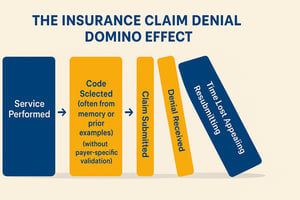


As a physical therapy or chiropractic student—or a recent graduate—managing billing and coding can...
Every week, your practice submits claims to insurance companies. Some get paid. Some don't. But do you know why?
If you're like most wellness practitioners, the answer is probably "not really." You might know that certain claims got rejected or denied, but understanding exactly what went wrong—and how to fix it—feels like decoding a foreign language.
Here's the uncomfortable truth: approximately 20% of all medical claims are denied, rejected, or underpaid1. Even worse? Up to 60% of these claims are never resubmitted1, which means that revenue simply disappears from your practice.
For a typical 5-provider physical therapy practice billing $750,000 annually, that could mean losing $90,000 to $150,000 every year—just because claims weren't properly managed.
The good news? This is a solvable problem. And modern AI technology is making it easier than ever to fix.
The Hidden Complexity of Insurance Claims
When you submit a claim to an insurance company, it goes through a multi-stage journey before you (hopefully) get paid. Understanding this journey is crucial to protecting your practice's revenue.
Stage 1: Initial Validation
Before an insurance company even looks at your claim, it runs through automated validation checks. These systems verify that:
- All required fields are filled out correctly
- Provider and patient information matches their records
- The claim is properly formatted
- You're not submitting a duplicate
If your claim fails any of these checks, it gets rejected immediately. The insurance company's system essentially says, "We can't process this—fix it and send it back."
Common rejection reasons include:
- A typo in the patient's insurance ID number
- Missing or incorrect provider NPI
- Wrong date format
- Mismatched patient name
The key thing to understand about rejections: your claim never actually entered the insurance company's payment system. It was stopped at the door. This means you can fix the error and resubmit—but it also means your timely filing clock is still ticking.
Stage 2: Adjudication (The Review Process)
If your claim passes validation, it moves to adjudication. This is where the insurance company actually reviews the services you provided and decides what—if anything—they'll pay.
During adjudication, they check:
- Is the patient's coverage active for these dates?
- Are these services covered under the patient's plan?
- Do the diagnosis codes support the treatment codes?
- Are there any coordination of benefits issues (multiple insurance plans)?
- Does this claim require prior authorization?
If something goes wrong here, your claim gets denied. Unlike a rejection, a denial means the insurance company received your claim, reviewed it, and decided not to pay it (or to pay less than you billed).
Denial reasons are often more complex:
- Service not covered under the patient's plan
- Missing prior authorization
- Treatment exceeded visit limits
- Diagnosis doesn't support the procedure
- Coordination of benefits issues
Here's the critical difference: once a claim is denied, you typically can't just fix it and resubmit. Many payers require a formal appeals process, which takes time, effort, and expertise.
Why This Matters for Wellness Practices
Physical therapy, occupational therapy, and chiropractic practices face unique billing challenges that make claim management even more critical.
The 8-Minute Rule
PT and OT practices must carefully track time-based therapy codes. Bill incorrectly, and your claim gets denied—even though you provided the service.
Multiple Procedure Payment Reduction (MPPR)
When you provide multiple therapy services in the same session, insurance companies often reduce payment for subsequent procedures. If you don't account for this correctly, you'll be caught off guard by underpayments.
Maintenance Care Limitations
Chiropractic practices frequently deal with denials around maintenance care versus active treatment. Documentation requirements are strict, and phrasing matters enormously.
Medicare Part B Therapy Caps
Even though therapy caps have exceptions, tracking them and submitting the necessary documentation is complex. Miss a step, and you're facing a denial.
The specialized nature of wellness practice billing means generic billing software often misses these nuances. You need tools that understand your specialty's specific requirements.
The Real Cost of Ignored Claims
Let's talk numbers. According to the American Academy of Family Physicians, the industry average denial rate sits between 5% and 10%2. But here's the shocking part: only 35% of providers appeal denied claims2.
Why? Because working denied claims is:
- Time-consuming: Staff spend hours researching denial reasons, gathering documentation, and writing appeal letters
- Complex: Understanding insurance policies and appeal procedures requires specialized knowledge
- Demoralizing: After weeks of work, many appeals are denied anyway
So practices make a business decision: it's not worth the effort. They write off the revenue and move on.
But when you add up all those written-off claims—plus the rejections that never got fixed, plus the underpayments nobody noticed—you're looking at a significant revenue leak.
How ClaimCode Changes the Game
This is where ClaimCode comes in. Instead of requiring your staff to manually track down claim responses, decipher cryptic insurance codes, and figure out next steps, ClaimCode automates the entire process using AI technology specifically designed for wellness practices.
Automatic Claim Monitoring
After you submit a claim (through your existing system), ClaimCode automatically:
- Monitors for responses from insurance companies
- Captures both immediate rejections and later denials
- Tracks partial payments and underpayments
- Organizes everything by claim status and reason
No more logging into multiple clearinghouse portals. No more waiting for paper remittances. Everything you need is in one place.
AI-Powered Explanations
Here's where it gets powerful. Insurance companies send back coded responses that look like this:
Status Code: A7:562:1P
What does that mean? Without ClaimCode, you'd need to:
- Look up code A7 (claim rejected)
- Look up code 562 (problem with National Provider Identifier)
- Look up code 1P (the provider's NPI specifically)
- Figure out which provider and which NPI field
- Determine how to fix it
ClaimCode's AI does all of this instantly and gives you a plain-English explanation:
"This claim was rejected because the billing provider's NPI doesn't match the insurance company's records. Check that you're using NPI 1234567890 (not 0987654321) for Dr. Smith when billing Blue Cross."
Even better, for specialty-specific issues, ClaimCode explains the why behind common wellness practice denials:
"This claim was denied because the diagnosis code (M54.5, low back pain) is considered a maintenance condition by this payer. To successfully bill for chiropractic treatment of low back pain, you need to document acute exacerbation, recent injury, or functional limitation. Consider adding diagnosis codes for radiculopathy or specific joint dysfunction."
Smart Analytics and Reporting
ClaimCode doesn't just explain individual claims—it helps you see patterns across your entire practice:
- Denial Trends: Which insurance companies deny your claims most often? Which procedure codes are problem areas?
- Provider-Specific Issues: Is one practitioner having more claim problems than others? (Could indicate a documentation or coding training opportunity)
- Financial Impact: How much revenue is sitting in rejected or denied claims right now? What's your practice's true denial rate?
- Time-to-Payment Metrics: How long does each payer take to process claims? Are you experiencing delays?
This bird's-eye view helps you make strategic decisions:
- Should you continue accepting certain insurance plans?
- Do you need additional coder training?
- Are there systematic documentation issues?
- Which claims are worth appealing?
Session-Based Workflow
Unlike generic billing software that organizes everything around claim numbers and transaction codes, ClaimCode organizes your work around sessions—the appointments where you actually saw patients.
This matches how you think about your work:
- "Did Mrs. Johnson's Tuesday session get paid?"
- "Are we having issues with our new patient evaluations?"
- "How many of last week's sessions are still pending?"
This intuitive approach means less time navigating software and more time actually solving problems.
The Bottom Line: Protect Your Revenue
Every rejected claim is a claim you can fix and resubmit. Every denial is a decision point: is this worth appealing, or should we prevent this issue next time?
But you can't manage what you can't see. And you can't fix problems you don't understand.
ClaimCode gives you:
- Visibility: Know exactly what's happening with every claim
- Understanding: AI-powered explanations in plain English
- Actionability: Clear next steps for every claim issue
- Insight: Analytics to prevent future problems
Most importantly, ClaimCode helps you reclaim the 10-20% of revenue that's currently slipping through the cracks.
Ready to Stop Losing Money?
ClaimCode is specifically designed for physical therapy, occupational therapy, chiropractic, and acupuncture practices. We understand your billing challenges because we've built our AI specifically for your specialty.
We're currently onboarding practices for our beta program. Book a demo to see how ClaimCode can help you:
- Identify revenue you didn't know you were losing
- Understand exactly why claims are being rejected or denied
- Get clear, actionable steps to fix problem claims
- See patterns in your practice's billing that need attention

Stop letting insurance companies keep money that belongs to your practice. Let ClaimCode's AI work for you.
Footnotes
-
Benchmark Solutions. (2025). "Differences Between Claim Rejections and Denials." Retrieved from https://www.benchmarksystems.com/blog/claim-rejection-and-denial-differences/ ↩ ↩2
-
AVS Medical. (n.d.). "Claim Rejections Vs. Claim Denials." Retrieved from https://www.avsmedical.com/avsmedical-blog/what-nextgen-office-users-need-to-know-about-claim-rejections-vs.-claim-denials/ ↩ ↩2